Showing posts with label DYM. Show all posts

Monday, 8 January 2018

Homeland Continuity Task

1. What was your role in the task and what did you actually do?
     My role in the production of our Homeland continuity task was to be the camera operator, i worked very closely with Alize who was the director and together in pre-production we came up with the shot list, which had all the details of the camera work such as, where it would be located, who it would be focused on and what type of framing it would be. In the actual production of our task i was mainly operating the camera and setting up the shots and getting the framing right, referring back to the shot list we had previously made. I also helped set up and organise where things were going to go in the room for the investigation scene, and occasionally chimed in with some comments which i thought would make our shoot more successful.

2. What factors did you have to take into account when planning, filming and editing?
     When planning our shoot i had to pay particular attention to the 30 degree rule and the 180 degree rule, which in certain areas of our shoot created a large problem for instance, the hallway scene where Derek and Harvey turn from greeting each other to entering the room. Alize and i spent quite a large chunk of our time working out how to shoot this scene while still following those rules. During filming it was fairly easy to follow these rules as we had already planned out our shots, we also had the interrogation table close to the wall which made it really easy to follow the 180 degree rule as it would've been difficult to film the scene from the other side of the 180 degree line. When i was editing the footage the most difficult part was getting match-on-action as the sound audio overlapped at places and so i had to use sound bridges and and overlay sound from one shot over another to give the task a better continuity flow.

3. How successful was your sequence? Did you manage to demonstrate match-on-action, shot-reverse-shot and the 180 degree rule? Did you achieve continuity overall?
     I believe that my sequence was very successful and i created a good edit of our footage for my Homeland continuity task. I believe i managed to demonstrate match-on-match action very well with all of the movement scenes, from Harvey's entrance through the white doors all the way til he leaves with Derek at the end of the interrogation. Another thing that i believe i managed to do well was the shot-reverse-shot between characters during the interrogation, which helped to build tension and also show the actor's facial expressions while still following the 180 degree rule and staying on the same side of that line. I firmly believe that i achieved a good standard of continuity over all, however a few of the cuts between shots look a bit jumpy but with the time i had i believed they were quite good and that my edit had a flow to it throughout its entirety.

4. What have you learnt from completing this task?
      From completing this task i have learnt the importance of good camera work withing a shoot, especially the framing of the shots. However the biggest thing i learnt, was the importance of planning because our shoot was very smooth and flowed very well and i believe this was because we split up into teams and each planned what we were going to do on the day of filming and what our specific jobs were, which made it a lot easier to get nice shots and not waste too much of our limited time, on our filming day.

Tuesday, 5 December 2017

My Magazine Cover


  1.  Summarise the music celebrity you have created.  Include name, music genre, personality and how they are being used to comment on contemporary celebrity.           My music celebrity is called Jack Willis and he is in an indie-rock band. He's a very famous drummer and is well known for his musical ability on the drums and his unorthodox approach to playing music, which makes him a hit with many younger and older fans across the world. Jack has a very laid back demeanor, and gives off an aura that he is a very mysterious person. The public and his fans don't know much about him and that's the way he'd like to keep it.                                                                                                                                                              
  2. Evaluate how you have constructed the representation of your celebrity through your cover image and cover headline/text (denotation/connotation of text and image).                I have constructed the representation of my celebrity so that he looks mysterious, this is denoted through Jack's squint and tilted head and connotes to the audience that there is something about him that is very mysterious as well as the fact that "An interview" is slightly whited out making it harder to read drawing people in to see and connoting his mysterious theme. He could be very dangerous or an ex-soldier, but the audience doesn't know what it is, they can't quite place their finger on it. This appeals to the audience as it drags them in because they want to know more about him and as the read the cover page they are given more of an idea into what he is like, with the taglines; "It was all about being strong," and "An interview with Jack Willis." This hooks the reader and convinces them to buy the magazine as maybe there will be more info on who Jack Willis is and what he did inside the magazine.                                                                                                                                                                                                                                                                                             
  3. Analyse how far you have used and/or challenged stereotypes of gender/race/age/sexuality in your cover.                                                                                                                                 In this magazine cover i have reinforced gender stereotypes with the phrase, "It was all about being strong," this says to the audience that as a man and especially in the music business he had to always be strong and there's no other way about it. This perhaps gives the reader an indication as to why he is so mysterious and closed off. It could also be an age related problem as well, being a young musician in a tough business, he had to be strong all the time, reinforcing both gender and age stereotypes.                                                                                                                                                                                                                                 
  4. Reflect on the production/editing process.  Are you pleased with the end result? Identify what is successful about your shot?  What would you have done differently in hindsight?  I am pleased with the end result of my magazine cover, i feel as though the whole production and editing process ran very smoothly and there were no problems in creating the cover. I believe my cover connotes the mysterious theme very well and i think i was successful in portraying that in my pose. In hindsight i probably would've spent slightly more time on the editing process if i could, but i believe it all turned out fine in the end anyway.

Wednesday, 8 November 2017

Current Music Video Analysis


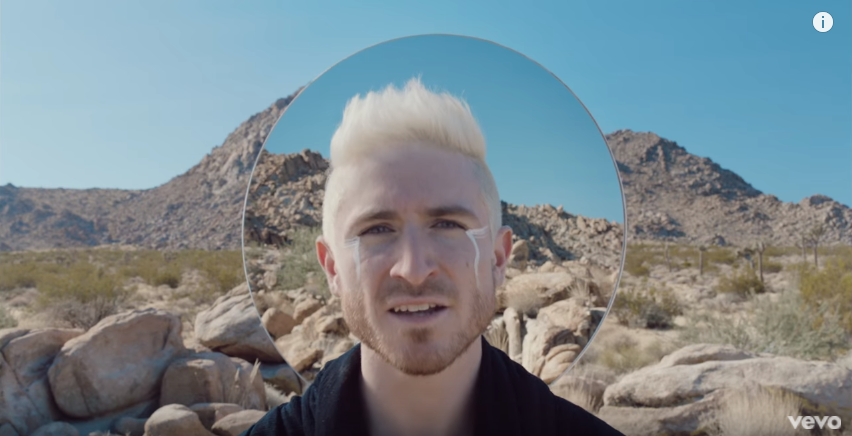
Close-Up Shots

Close up shots are a convention of music videos as they give the audience a detailed view of the person on the screen, and show what they are thinking, with the audience being able to see the singers emotions and facial expressions as they deliver their lines.


Visual Illustration of Lyrics


In the video lead singer Nicholas Petricca says, " You and I will walk into the emptiness," and this is sung as the shot changes to him walking alone in a desert, 'the emptiness,' which helps emphasise to the audience what he is trying to get across, with a visual stimulus.


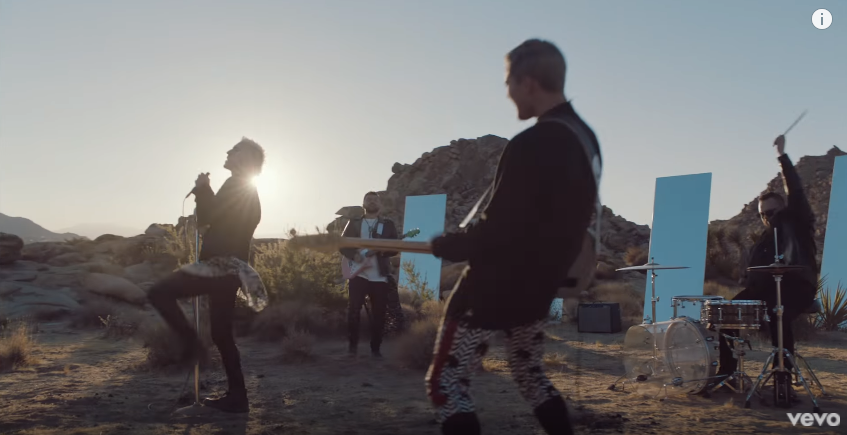
Shots of the Artists Performing

Another convention of music videos are shots of the artists performing their song. It usually has a shot of the entire band together, but then breaks away into different shots for each member of the band, when their instrument is the main one playing.


Direct Address

Direct address is common for male singers, this involves the character looking towards the viewer. The male is seen to be addressing the viewer directly. He is supposed to be singing directly for you. This helps the audience pay attention and engage with the video as they feel required to continue watching.

Cutting to the Beat

Cutting to the beat is very common in music videos and is done in this music video, with the main shot suddenly switching to the band at the start of the chorus, and then changing shots in time with the beat until the end of the chorus.


Wednesday, 20 September 2017

Film Trailer Analysis: The Expendable's 2

Audience Appeal

  • The trailer opens with the Lionsgate logo which is synonymous with action movies and will appeal to people watching the trailer, who are fans of Lionsgate's other action films.
  • My film is also the second instalment in the series, and as such many fans are already attracted to the film and this is helped with the expendable's logo's we see.
  • My film features lots of action shots and is appealing to the target audience because of that, it gives them a sense of everything that is to happen in the film.
  • Another appealing factor of my trailer is that it features many famous actors, so it may entice fans of those actors to watch the film, and their names are put up at the end of the trailer helping the audience find out who is in the film.
Branding and Studio Identity 

  • At the start of the trailer the Lionsgate and Millennium logo's appear and help the audience identify with other films made by them, and give them an understanding of what the film is about. 
  • The film is also branded at the end by using the actors names to attract people because the film features some very famous actors.
  • There is also a link to the films facebook page at the end, which will help the audience learn about the branding of the film and what it's about in even more depth.
Character and Representation
  • All the main characters in this trailer are presented as ex-soldiers who have now turned into mercenaries, which gives the audience a hardcore feel about the characters and helps set the scene for the characters to develop.
  • The protagonist, Barney, is seen to be doing an ex-employer a favour and gives a bit of detail about his life, as well as when he says, "it's my lucky ring," we feel as though we know him better.
  • Finally we also see that they all mess around and joke with eachother which gives off the appeal of a film all about camaraderie and sticking together while including comedy and action scenes as well.
Genre signifiers
  • There are many action shots in my trailer, such as the very first shot which shows the characters zip-lining over a forest, and immediately gives the audience a sense of the action genre.
  • The genre is also signified by the soundtrack which builds tension for the audience and lets them know that the characters are in trouble, which signifies the action genre.

TV Drama Still Evaluation


1.       My chosen shot features two actors and is framed as an OTS shot. Both of the characters are wearing white and are facing each other, with one of them standing in a lift as the doors close. This signifies an important element in the legal drama genre as these type of shots build up tensions for the audience and creating a cliff hanger with the audience wanting to know what happens next, that's why it's common for them to feature at the end of episodes.

2.       To achieve my desired effect I positioned my first actor in the lift and had him look at my second actor, with a disappointed expression, to express to the audience that my second actor had done something wrong to him. For my other actor I had him facing away so that the audience cannot see his face and therefore do not know how he feels which creates a sense of mystery to the scene. I also had both actors in white so that it connotes that they are in a uniform and that they work together, and finally I took the image just as the doors were shutting to create a closing effect on the scene and the audience.

3.       I intended for my dominant reading to be that there had been some wrong doing between the characters and that one of them was leaving as he looks disappointedly, at the other character. This narrative is intended to leave the audience asking questions as they don't know what happened next, and intrigue them to find out how the situation was resolved.

4.       My shot is successful because it features many of my genres convention, for example, there is a sense of mystery between the characters as we don't know how they are feeling or who they are entirely which intrigues the audience. My shot is also successful because it gives the audience a sense of setting and allows them to relate to the situation.

5.     In hindsight I would put my first actors hand on the lift button, and I would also position my actors closer together to give the audience a more personal feel to the shot.